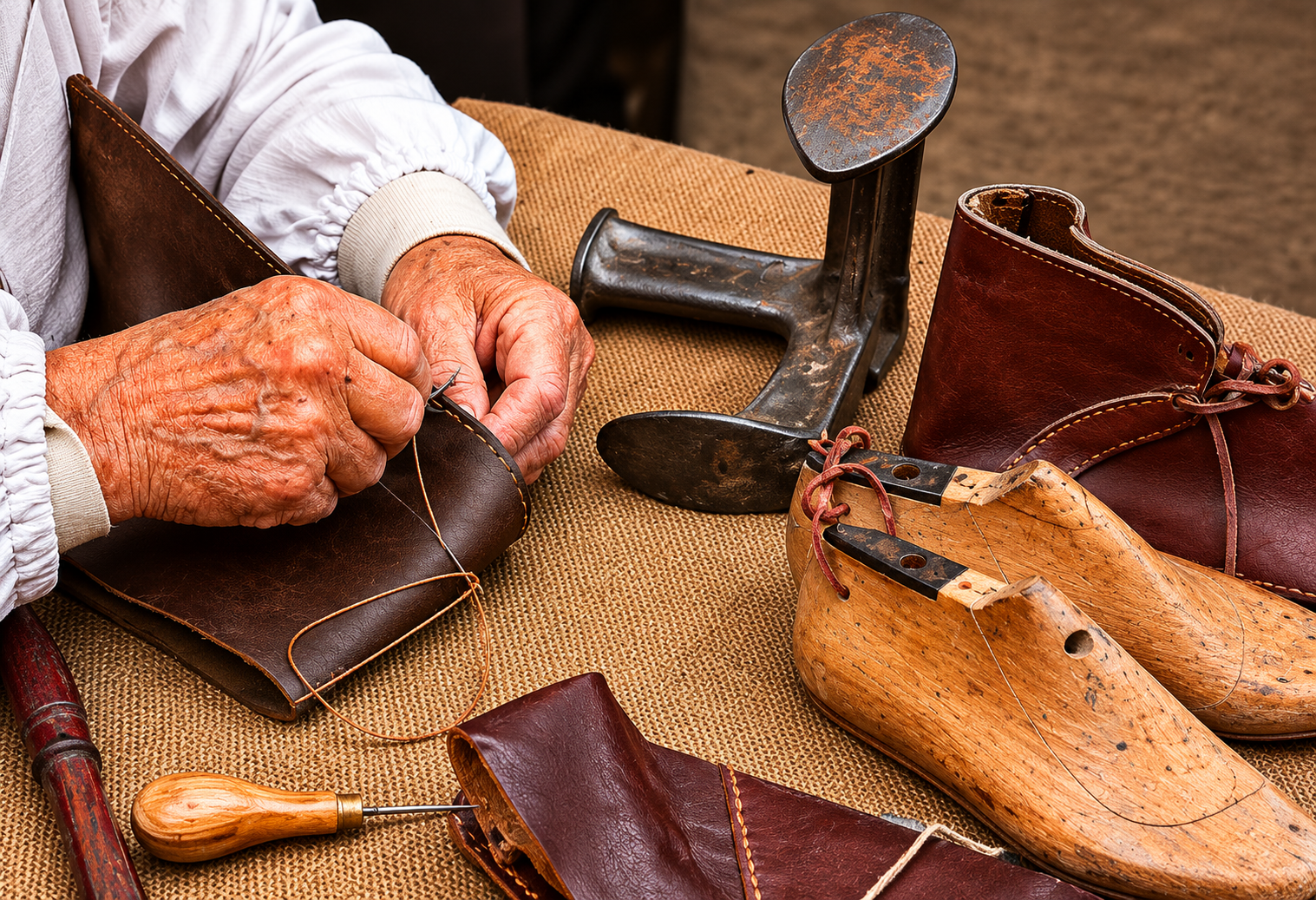
How KHRAAV makes things

The hands
that make it
matter.

Every object that leaves a KHRAAV workshop passes through more than a dozen acts of deliberate human intention before it reaches you. This is not specific to one product. It is the standard the house is built on and the standard every future collection will be held to.

A word older than any
factory that exists today.

Khraav. In Kashmiri, it names a piece of wooden footwear that villagers carved from willow, mulberry, or pecan wood shaped in a day by a carpenter in exchange for rice, worn through snow when nothing else existed to protect the foot. The word predates modern shoemaking by centuries. It is a word that belongs to a people who understood, before the industrial age was even imaginable, that the right object made from the right material by the right hand was its own form of wealth.

Pulhoer, the other name we carry is equally ancient. Woven from straw rope by the hands of Kashmiri artisans for generations, Pulhoer was the winter companion of an entire civilisation light, natural, made from what the land offered. Both Khraav and Pulhoer are footwear made with patience from available material. Both are made the way Kashmir has always made things by a person, in a room, taking time.

KHRAAV is not a revival project. It is a continuation. The name carries the memory of those makers, and every object we make, beginning with PULHOR, our debut collection, and extending into everything that follows, carries their standard.

Srinagar: a city
that still makes things.

In 2021, Srinagar was designated a UNESCO Creative City in the field of Crafts and Folk Art a recognition that formalises what the Valley has always known about itself that it makes things the world cannot find elsewhere. At the centre of that identity is a single principle, carried across every medium Kashmir has ever worked in. Time is the most expensive material. The things worth owning are the things that have absorbed it.

Kashmir's leather-working tradition is as old as its weaving tradition. The Gurgabi, a traditional Kashmiri leather shoe crafted during the Mughal era was once known across the subcontinent for a quality that distinguished it on sight. The hands that made it learned their trade the same way every Kashmiri artisan learns from a parent, in a workshop, over years. KHRAAV is the continuation of that specific lineage. Not a revival. Not a reference. A continuation because the knowledge never left. It was only waiting for a house built to carry it.

"The loss of an artisan is not just a lost job — it is a silenced tradition and an incomplete culture."

KHRAAV is made in the city and valley that produced all of this. Our workshop sits among the descendants of the carvers, weavers, and tanners who have practised to this standard for a thousand years. That is not a marketing statement. It is geography. It is the reason we are here and not somewhere else — and why every collection we build will be built here.

Kashmir's craft industry today employs approximately 50,000 artisans, but the pressures against it are real. Machine-made replicas, underpaid middlemen, and a younger generation drawn to easier livelihoods have put crafts that survived a millennium under genuine threat. Buying from KHRAAV is, among other things, a statement about which version of Kashmir's future you are willing to support.

How a KHRAAV
piece is made.

The process behind our debut collection, PULHOR and the standard every future piece is held to.

01

The leather is selected by hand.

Full-grain leather the highest grade, taken from the outermost layer of the hide is assessed by touch and sight before cutting begins. Each hide carries its own grain pattern. Our craftspeople select for even grain density, consistent thickness, and the suppleness that signals the leather has not been corrected or buffed. A hide that passes this stage is already a rare thing.

02

Patterns are traced, not stamped.

There are no die-cut machines in our process. Each upper is traced around a paper pattern onto the leather by hand, then cut with a sharp knife along the grain. This gives the cutter control over which part of the hide goes where directing the finest area to the toe, preserving the grain direction that will give the leather its eventual patina. Die-cutting does not make this distinction. Hands do.

03

The shearling collar lining is fitted.

Natural cream wool fleece Merino grade, the same category of fibre that Kashmir has traded in luxury form for centuries as Pashmina is fitted inside the collar before the upper is lasted. The shearling is cut to conform precisely to the collar shape, then secured in a way that holds through years of wear. There are no synthetic inserts, no bonded foam substitutes. What sits against your skin is wool as it came from an animal.

04

Lasting: the upper is pulled into form.

The cut leather upper is stretched over a shaped wooden last the form that will give the piece its final silhouette. This is the moment where a flat piece of material becomes a three-dimensional object. The leather is dampened slightly, then pulled with lasting pliers around the contours of the last with deliberate tension. This step cannot be rushed lasting too quickly produces a misshapen collar and a fit that will loosen unevenly. Our craftspeople know what the correct tension feels like in their hands.

05

The memory footbed is assembled.

A layered inner sole arch-contouring foam beneath a moisture-wicking fabric cover is shaped to sit inside the lasted upper. The footbed is built in layers because no single material provides everything the foot needs for all-day wear, the bottom layer distributes pressure, the middle layer absorbs impact, the top layer manages moisture. The assembly is precise; a footbed that shifts even slightly will compromise the arch support.

06

The centre seam is hand-stitched.

The signature of every KHRAAV piece. Running from the toe to the collar, the centre seam is stitched by hand using a curved needle and waxed thread, pulling through both sides of the upper in a continuous awl-and-thread rhythm. This seam does two things simultaneously it holds the upper's shape from the inside out, and it creates the single most visible mark of construction on the piece. A machine stitch has regularity. A hand stitch has character. You can see the difference, and over time, so can the leather.

07

The rubber sole is attached by stitching, not glue.

The off-white rubber outsole is precision-moulded for grip and silence, then attached to the lasted upper by hand-stitching through the welt. No adhesive is the primary bond. Glued soles fail at their boundaries over time, the bond weakens with heat and moisture. Stitched soles fail only when the thread gives out, which for waxed thread under normal wear, is a very long time. This choice adds hours to the making process. It also adds years to the product's life.

08

Finishing and quality review.

The last is removed. The leather is conditioned with a wax-based balm that nourishes the grain without altering it. The seam is inspected for consistency. The collar is pressed into its final shape. The sole's edges are trimmed to exact alignment with the upper. Finally, the pair is checked against its partner, left against right to confirm that the grain, the stitch, and the silhouette are matched. Only then does it leave the workshop.

Signature Seam Detail

Every stitch is
placed once.

The hand-stitched centre seam is not decorative. It is structural, a spine that runs the length of the slipper and holds the upper's leather in consistent tension from front to back.

Kashmir's craft traditions are full of this kind of thinking, details that are both beautiful and load-bearing. The centre seam on every KHRAAV piece is made the same way. It takes as long as it takes. It cannot be accelerated without losing something visible. That is exactly the point.

162+ Hours of human craft in every pair

From material selection to final quality review, every KHRAAV piece passes through multiple skilled hands across multiple days. No stage is automated. No stage is optional. This is the floor, not the ceiling each new collection we build will meet or exceed it.